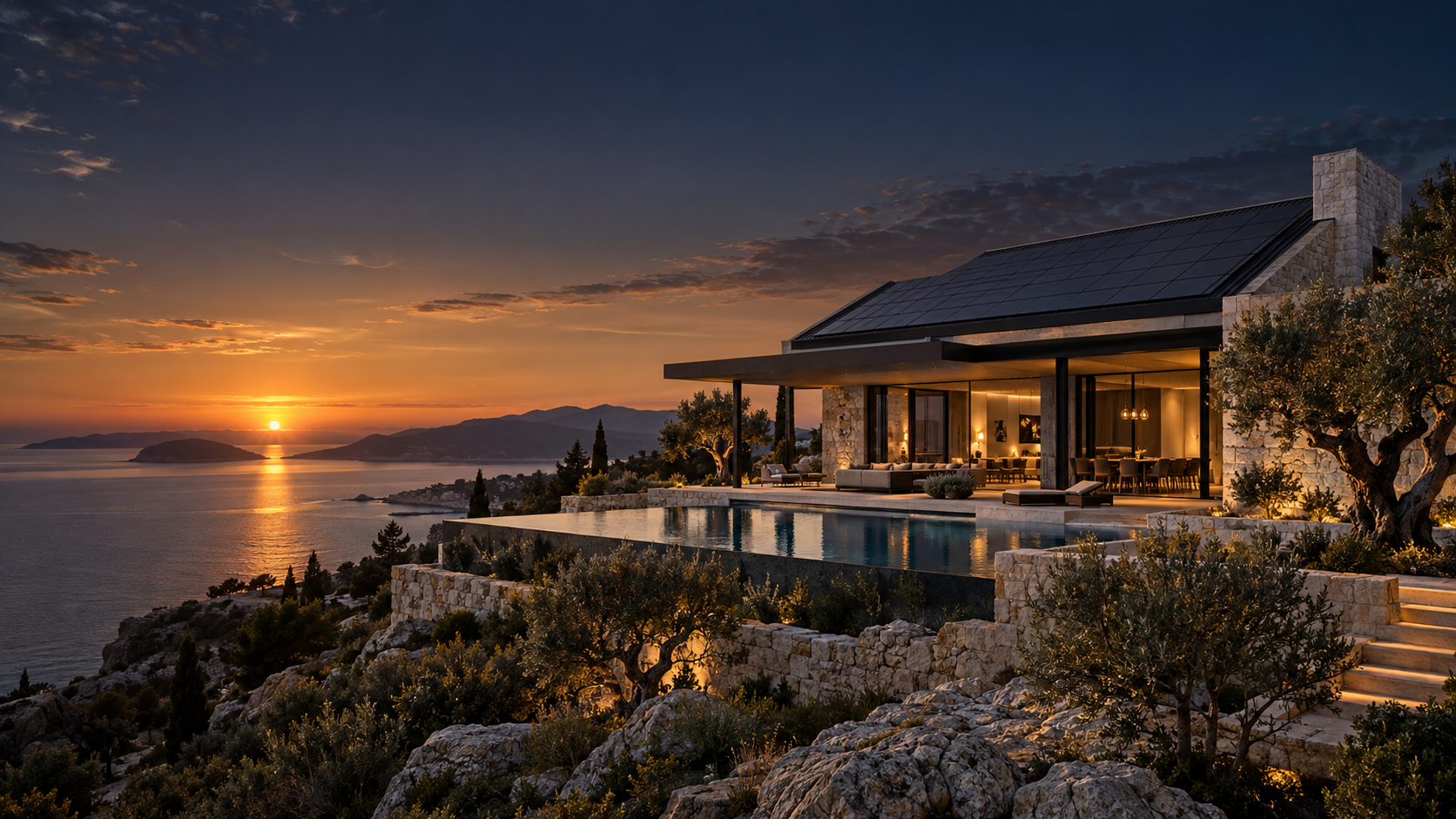
Choosing solar is not only about electricity generation. The condition of your roof, the appearance of your home and the way the system will be maintained all belong in the decision.
Panels mounted above a roof and solar tiles integrated into its covering can both generate electricity. Their main difference is their role in the building: an addition to the roof, or part of the roofing system. Neither is the right answer for every home.
| Consideration | Panels above the roof | Integrated solar roof tiles |
|---|---|---|
| Building function | Electricity generation above a separate roof covering | Electricity generation as part of the roofing system |
| Appearance | A panel array visible above the roof | Potential for a continuous, integrated roof surface |
| Sound existing roof | Installation may be possible without replacing all the covering | Integration may require roof replacement and substrate changes |
| New or replacement roof | Roofing and an array above it are planned together | Roofing and generation are designed as one integrated solution |
| Maintenance | Access to panels, connections and the roof underneath | Replacement must also preserve the roof covering and waterproofing |
| Performance assessment | Depends on the product, layout and site conditions | Depends on the product, active area and site conditions |
Above the roof, or part of it?
In a conventional rooftop installation, the covering remains the roof and panels are installed on a mounting system above it. With building-integrated photovoltaics, or BIPV, the photovoltaic components replace some conventional roof materials and become part of the envelope.
Solar tiles are not the entire roof. An integrated solution still needs suitable supporting layers, waterproofing and drainage details, ridges, edges and connections. Non-generating infill elements can complement active tiles where the selected system allows.
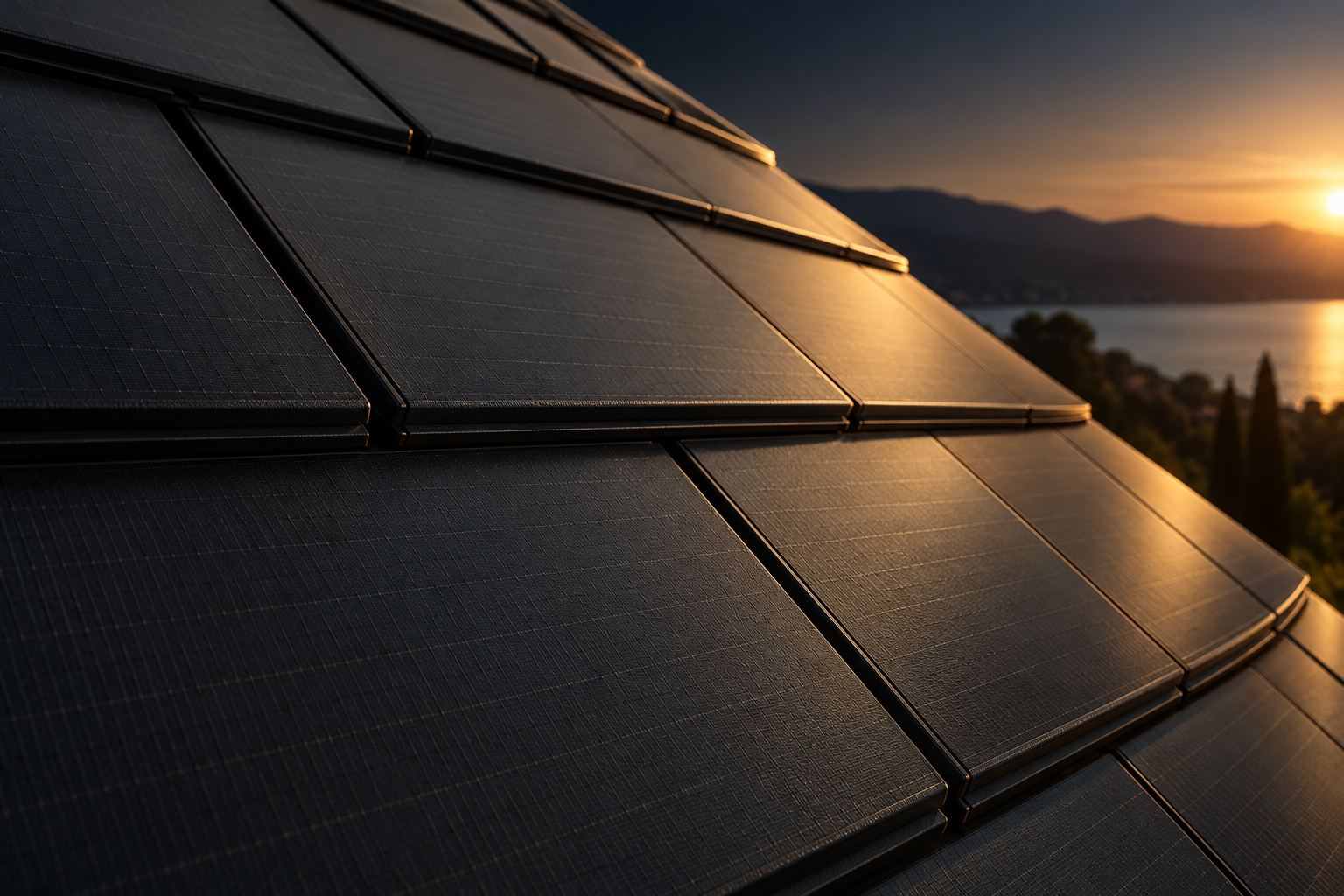
Architecture: more than the colour of a tile
When the roof is a prominent feature, integration matters. Solar tiles can reduce the appearance of a separate array above the covering. Rooftop panels generally create an additional visible layer, whose position and layout can also be designed carefully.
Review a layout and visualization for either option. Look at ridges, edges, roof windows, chimneys and the transitions between active and non-active areas. A uniform appearance depends on the actual product and detailing, not merely the technology label.
A sound existing roof deserves a proper assessment
If your roof is in good condition and the main aim is to add generation, begin by assessing rooftop panels. Review the covering and structure, loads, orientation, shading and maintenance access.
Switching to solar tiles is not necessarily a simple tile-for-tile exchange. Supporting layers, edge details and waterproofing may need to change. Removing a sound roof should not be assumed to be the best choice.
New construction or roof replacement changes the comparison
When a new roof is already planned, compare complete roof-and-solar solutions rather than individual products. Both alternatives should cover the same scope of roofing and electrical work.
Early coordination between architectural, structural and electrical designers and installers can address roof slopes, openings, active area, cable routes and equipment locations. This does not guarantee that one solution will be preferable; it makes the implications clearer before construction.
Waterproofing and drainage need design in both cases
With panels above a roof, review how fixings and penetrations interact with the existing covering and waterproofing. With integrated tiles, review tile connections, supporting layers, edges, ridges and junctions around openings.
Integration alone does not prove better watertightness, and rooftop panels do not inevitably cause leaks. Product suitability, design and workmanship matter. Request installation details and clear responsibility for roofing, waterproofing and electrical work.
Plan for maintenance and replacement
A rooftop array needs access to its components and to the covering underneath. A later roof replacement may require the array to be removed and reinstalled.
For integrated tiles, establish how a failed unit is replaced, what must be removed, how waterproofing is restored and who performs the work. Spare parts, documentation and service should inform the choice. Do not assume that components from different manufacturers are interchangeable.
Follow the system's maintenance instructions and use appropriately qualified professionals. This article is not an installation guide or instructions for roof or electrical work.
Which generates more? The label cannot tell you
The words 'tile' and 'panel' are insufficient to predict output. A comparison needs specified products, layout, active area and a forecast that considers orientation, slope, shading and installation conditions.
Distinguish total roof area from generating area, and installed capacity in kilowatts-peak from annual energy in kilowatt-hours. Ask for two designs for the same roof using consistent assumptions. Architectural integration does not, by itself, guarantee higher generation.
Choosing for your home
Start with a roof plan and photographs. State whether the project is new construction, a sound existing roof or a covering already due for replacement. Explain your priorities: retaining the existing roof, appearance, generation or a complete redesign.
Then request a defined scope: roofing and electrical equipment, waterproofing, approval requirements, service arrangements and the warranties applying to each component and type of work. Avoid comparing proposals with different scopes.
VOLTECTA focuses on the relationship between roofing and energy. An initial assessment should establish whether integration suits your building and plans, rather than assume that every home needs solar roof tiles.
Technical sources
U.S. Department of Energy — BIPV
Building a new home or replacing a roof?
Send a roof plan or building photographs for an initial suitability review.
Assess your roof→