
BIPV stands for Building-Integrated Photovoltaics. The idea is that a component contributes both to electricity generation and to the function of a building.
When considering solar roof tiles, ask not only how much electricity a product generates or how it looks, but also what role it performs in the roof.
The test: what happens if the component is removed?
The definitions reviewed by IEA PVPS describe a dual electrical and building role. Removing a BIPV component means an appropriate conventional building component would be needed in its place. This differs from solar equipment mounted on a roof that functions separately.
In an integrated roof, an active element may replace part of the roof covering. It is not a complete roof on its own: its exact role depends on the product and the assembly.
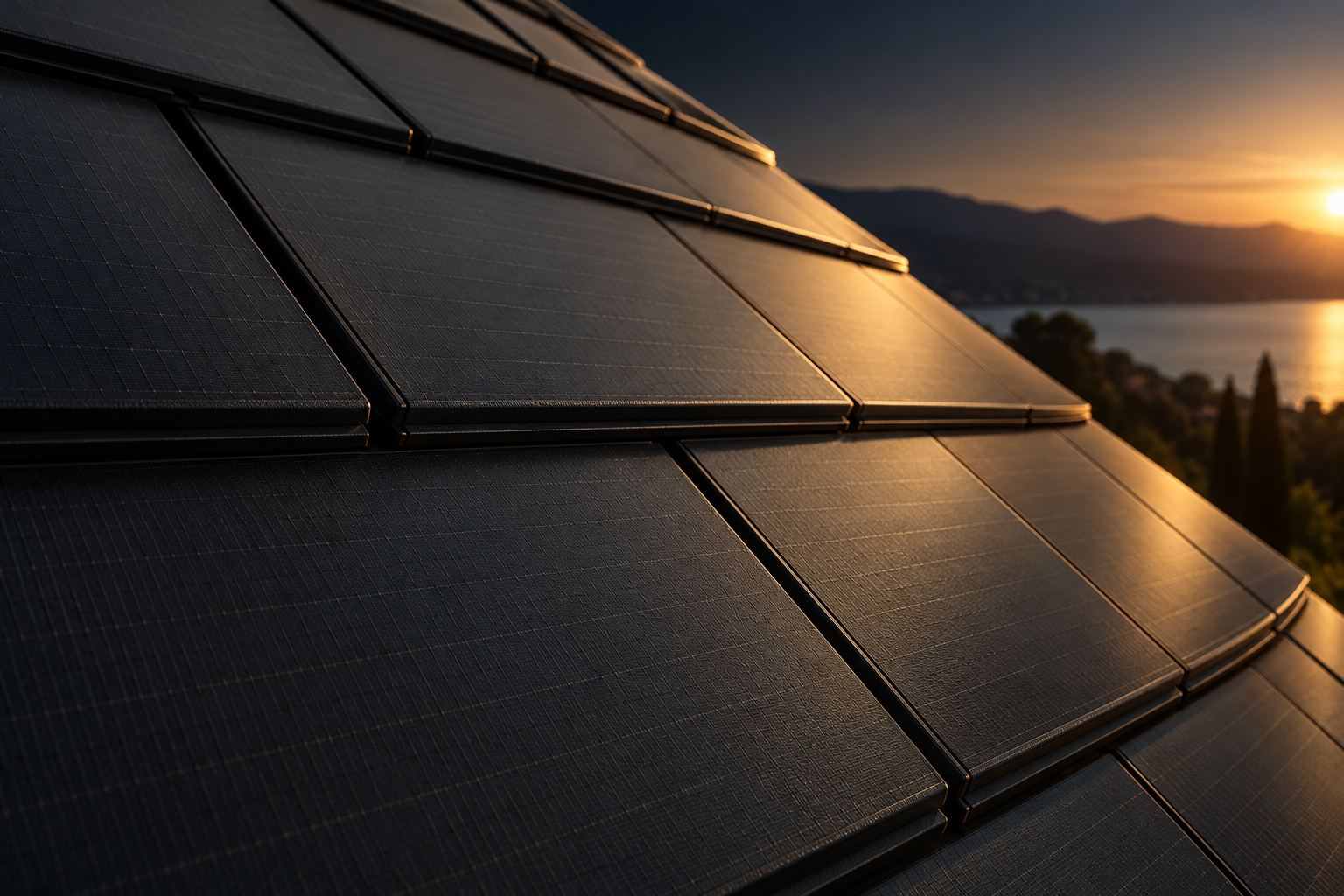
A consistent appearance is not the definition
A uniform black roof can look impressive, but colour or a close-fitting installation alone does not establish BIPV. Integration also needs a building function.
Ask to see both a component layout and a roof connection detail. A visualisation explains appearance; drawings and specifications should explain function and integration.
Solar roof tiles are one application in a broader family
BIPV can be used in roofs, façades, skylights and other envelope elements. The U.S. Department of Energy describes solar-generating materials replacing some conventional building materials.
Each application has its own architectural and functional context. A façade product is not necessarily suitable for a pitched roof, and similar appearance does not imply the same installation method. VOLTECTA’s assessment focuses on the proposed tile system’s suitability for the particular roof.
Evaluate an assembly, not just a tile
Organise the discussion around three questions: what the product does as roofing, how it connects electrically, and how it will be maintained. IEA PVPS’s technical guidebook covers architectural integration alongside performance, safety, operation and maintenance.
Ask how edges, ridges and openings are detailed, where connections run and how components can be accessed for service. These questions help establish scope and responsibility beyond the word integrated.
Four questions for a suitability meeting
What part of the roof assembly does this product replace, and what layers and infill components are still needed?
Are drawings and specifications available for the proposed model and my roof conditions?
Who coordinates roofing, structural and electrical design?
How are components inspected, maintained and replaced, and what does each party’s warranty cover?
What changes when choosing a roof?
BIPV brings electricity generation into the choice of building materials. It invites architects and system designers into a shared discussion before roof decisions are finalised.
The term itself is not a quality label, project approval or yield guarantee. Start by identifying the product and application, then assess the complete system. For an initial VOLTECTA suitability review, share roof drawings or photographs, the location and the project stage.
Technical sources
Technical background, not an endorsement of a VOLTECTA product or project.
IEA PVPS — International definitions of BIPV
Building a new home or replacing a roof?
Send a roof plan or building photographs for an initial suitability review.
Assess your roof→